The simplest secure way to attach a cooler to a paddle board is with two cam straps: run each strap through a D-ring (or tie-down point) on the board and through the cooler’s tie-down slot or handle, then cinch it tight. A small soft cooler can just go under the deck bungee, but a hard cooler needs straps so it can’t slide off when you wobble.
Don’t screw anything into your board. Most “cooler tie-down kits” come with screw-in deck plates meant for boats and truck beds. On a paddle board, use the straps and buckles and skip the screws.
Quick answer
- Small soft cooler or deck bag: under the bungee, plus a short strap to a D-ring if you have one.
- Hard cooler: two cam straps through the board’s D-rings and the cooler’s tie-down slots, one each side.
- Placement: on the deck behind where you stand, or in front on a long board, as close to the middle as you can.
- Never drill or screw into a paddle board, inflatable or hard.
- Check the weight: a loaded cooler eats into your board’s capacity.
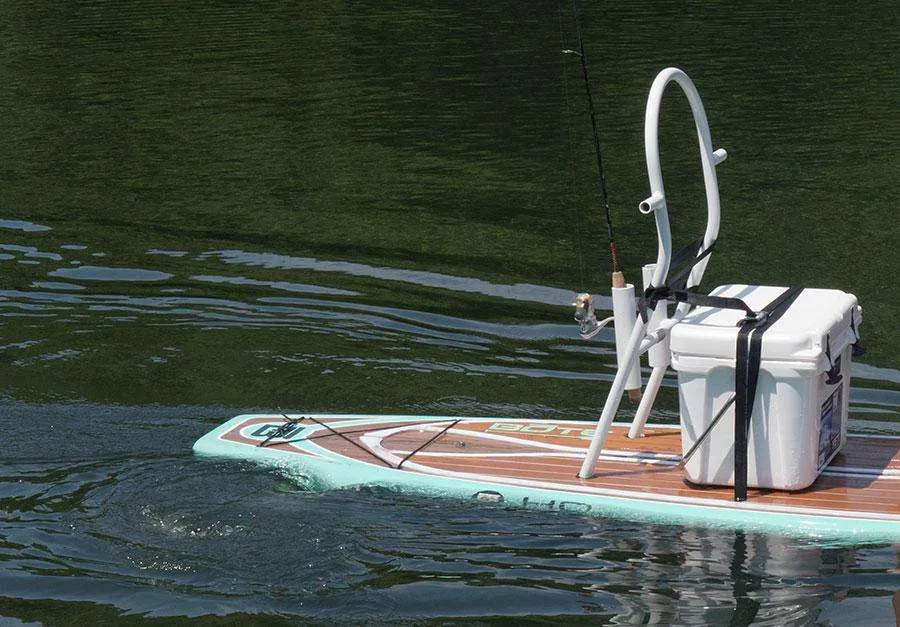
How to strap a cooler to a paddle board
You need two cam straps (or the straps from a cooler tie-down kit) and a board with D-rings or bungee anchor points near where the cooler will sit.
- Pick the spot. Most people put the cooler on the rear deck behind their feet, over the bungee area. Keep it as close to the center of the board as you can while still leaving room to stand.
- Find your anchor points. Look for a D-ring on each side of the board near that spot. Many inflatables have four D-rings around the front and rear bungee areas.
- Thread the first strap. Run it through the D-ring on one side, up through the cooler’s tie-down slot (or under the handle), and back to the cam buckle.
- Repeat on the other side.
- Cinch both straps tight, pulling down so the cooler is pinned to the deck. BOTE’s instructions for its KULA cooler note that feeding the strap through the back of the buckle stops it loosening as you paddle.
- Tuck the loose ends under the bungee so they don’t trail in the water or catch your feet.
- Test it on land. Push the cooler hard from each side. If it moves, tighten or re-route the straps.
To take it off, lift the cam buckle tab, loosen and slide the straps out.
If your board has no D-rings where you need them
- Use the bungee anchor points. Run straps through the bungee lacing as well as under it, so they pull against the anchors, not just the stretchy cord.
- Wrap straps around the whole board only on a hard board, and pad them so the buckle doesn’t scratch the rails.
- On an inflatable, you can glue on extra D-rings made for iSUPs. Tower sells them in packs of four; they attach with PVC adhesive and need about 24 hours to cure before use.
Choosing a cooler for a paddle board
- Size: a 20–35 quart hard cooler fits the rear deck of most all-around boards. Anything bigger starts to get in your way.
- Weight: ice, drinks and food add up quickly. Count the loaded cooler toward your board’s weight limit, along with you. Our Board Fitter can tell you if your board has room for gear.
- Tie-down slots: hard coolers from brands like YETI and RTIC have molded slots that cam straps feed straight through.
- Soft deck coolers: lighter, and they sit under the bungee. Good for drinks and lunch on a half-day paddle.
For specific coolers, see our best paddle board coolers.
Cooler tie-down kits
These kits are sold for boats and trucks, so they include screw-in deck plates. On a paddle board, the useful parts are the straps and stainless steel cam buckles, which are tougher than cheap ratchet straps. Strap length matters: longer straps reach from side D-rings over taller coolers.
YYST Cooler Tie-Down Kit
Nylon straps with 316 stainless steel cam buckles and deck loops. The 54-inch straps are long enough for tall coolers.
| Straps | 2, 54 in, UV-resistant nylon |
| Hardware | 316 stainless steel buckles and deck loops |
| Price | Around $15 at the time of writing |
Pros: cheap; marine-grade stainless; long straps. Cons: you may need to trim the straps for a small cooler.
AIEVE Cooler Tie Down Kit
Two nylon straps with stainless cam buckles and two stainless brackets, sold with YETI and RTIC coolers in mind.
| Straps | 2, about 47 in |
| Hardware | Stainless steel brackets and cam buckles, 8 screws |
| Price | Around $16 at the time of writing |
Pros: inexpensive; strap length suits medium coolers. Cons: shorter straps may not reach from widely spaced D-rings.
Kuuma 51960 Cooler Tie Down Strap Kit
Two straps, two stainless mounting brackets and eight screws, from a marine and RV accessory maker.
| Includes | 2 straps, 2 stainless brackets, 8 stainless screws |
| Warranty | 1 year (per listing) |
Pros: stainless hardware won’t rust. Cons: pricier than the generic kits for what you’ll use on a board.
Universal Cooler Tie-Down Strap Kit
Two nylon straps with cam buckles plus two stainless deck plates. At about 79 inches these are the longest straps here.
| Straps | 2, about 79 in, nylon |
| Hardware | Stainless steel deck plates, 8 screws |
| Price | Around $16 at the time of writing |
Pros: long enough to go around big coolers or the whole board. Cons: lots of spare strap to tuck away on a small cooler.
Alternatives to a hard cooler
If you only want a few cold drinks, skip the hard cooler:
- A soft deck cooler bag that clips under the front or rear bungee. Thurso Surf and iROCKER both make SUP-specific ones.
- An insulated drink holder that sits in the bungee. See our best paddle board drink holders.
- A collapsible insulated lunch bag with a shoulder strap that folds flat when it’s empty.
Bungee looking tired? Here’s how to tie a bungee on a paddle board.
FAQ
Can I just put a cooler under the bungee?
A small soft cooler, yes. A hard cooler is too tall and heavy for bungee alone and can pop out when the board tips. Strap it to the D-rings.
Where should a cooler go on a paddle board?
Usually on the rear deck behind your feet, close to the middle. Too far back and the tail sinks; too far forward and it’s in your stroke. On long fishing boards, a cooler in front of you can double as a seat.
Will a cooler make my paddle board unstable?
A heavy cooler raises the center of gravity and adds weight, so the board sits lower and feels tippier. Keep it low, centered and strapped tight, and don’t overload the board.
Can I sit on a cooler on a paddle board?
On wide, stable fishing boards many people do. Strap it down firmly first, and check the cooler is rated to take your weight.