To stand up on a paddle board, kneel in the middle of the board near the carry handle, put your hands down, and bring one foot up at a time to where your knees were. Then rise slowly with your knees bent and your eyes on the horizon, not your feet.
Most people fall on the first try, and that’s normal. Calm water, a wide board and a slow, staged stand-up make it far easier.
Quick answer
- Pick calm, knee-deep water where the fin clears the bottom, with your leash on and your life jacket on.
- Kneel by the handle, in the middle of the board, and paddle a few strokes on your knees.
- Hands on the board, paddle out of the way, then one foot up at a time.
- Rise slowly: chest up first, legs straighten last. Pause in a half-squat if you wobble.
- Feet parallel, about hip- to shoulder-width apart, knees soft, eyes on the horizon.
- Fell off? Climb back on and kneel again. See how to get back on a paddle board after falling.
Before you try
Set yourself up so the first stand-up is as easy as it can be:
- Water: flat and shallow, near a shore or dock. Avoid wind, boat wakes and waves for your first sessions. Our guide to the best conditions for paddle boarding shows what to look for.
- Life jacket: wear it, even if you swim well. In the US a board counts as a vessel outside swim and surf areas, and the Coast Guard says it needs a life jacket there. Details are in do you need a life jacket on a paddle board.
- Leash: attach it to your ankle or calf and check it’s secure so the board doesn’t drift off when you fall.
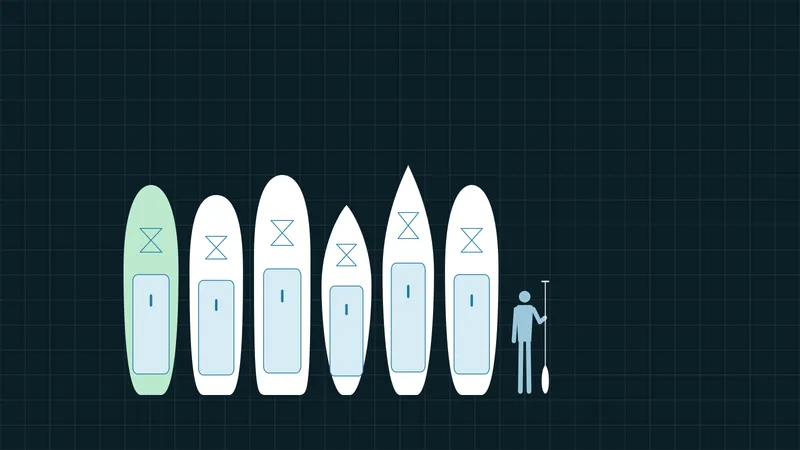
- Board: a wider, thicker board is more forgiving. Glide suggests at least 33 inches wide for beginners. Not sure what suits your weight? Try the Board Fitter.
Step 1: Get on and kneel
Walk the board out until the fin is clear of the bottom, lay the paddle across the deck and climb on. How to launch a paddle board properly covers this in detail.
Kneel in the middle of the board, with your knees on either side of the carry handle. That’s where the board sits most level. Glide and Discover Boating both suggest paddling a little on your knees first, so you feel how the board reacts.
Step 2: Move your feet up, one at a time
- Rest the paddle across the board in front of you, or lay it flat so it’s out of the way.
- Put both hands on the board in front of your knees. Your hands do the stabilizing while your feet move.
- Bring one foot up to the spot where that knee was, then the other.
Move slowly. A sudden shift of weight is what tips most beginners in.
Step 3: Rise slowly
From a crouch with your hands down, lift your chest first. Keep your knees bent and straighten your legs gradually until you’re upright.
If you feel shaky, stay in a half-squat for a few seconds. Both Glide and Discover Boating advise dropping back to your knees if you wobble. Nobody is judging.
Step 4: Find your stance
- Feet: parallel, pointing forward, about hip- to shoulder-width apart. Sources vary a little on exact width, so use whatever feels stable.
- Position: centered between the rails, roughly where your knees were, over the handle.
- Knees: slightly bent so they absorb small waves and wakes.
- Back: straight, upper body relaxed, core lightly engaged.
- Eyes: on the horizon. Looking at your feet is a classic way to lose your balance.
Once you’re up, pick up the paddle and take a few short strokes. A moving board is steadier than a still one. Check how to hold a paddle board paddle so the blade angles forward.
Common mistakes
Glide lists several slip-ups that cause most early falls:
- Looking down instead of ahead.
- Locking your knees straight.
- Standing too far back on the board.
- Holding the paddle with the blade angled toward you.
- Trying to learn in wind or waves.
More in 12 paddle boarding mistakes beginners make.
If you keep falling
- Fall away from the board if you can, rather than onto it.
- Go back to your knees and paddle from there until you’re steady. Kneeling is a perfectly good way to paddle.
- Practice the move a few times on calm water, near the shore, until the kneel-to-stand sequence feels automatic.
- Work on balance with the tips in how to improve balance for paddle boarding.
- Check the board. A board that’s too small or narrow for your weight feels much more tippy. Use our Board Fitter or read what size paddle board do I need.
FAQ
Should I kneel or stand first on a paddle board?
Kneel first. It gives you a low, stable position to feel the board and a staged route to standing. You can also paddle from your knees if you aren’t ready.
Where should my feet go on a paddle board?
Parallel and centered between the rails, around the carry handle, about hip- to shoulder-width apart. Standing too far back is a common beginner mistake.
Why can’t I balance on my paddle board?
Common causes are looking at your feet, locking your knees, standing off-center, or conditions that are too rough. Also check whether the board is wide enough for you.
How long does it take to stand up on a paddle board?
There’s no fixed time. Many people manage it within their first session on calm water, and others need a few trips. Keep sessions short and kneel whenever you need a rest.
Do I need to wear a life jacket just to learn?
Yes, wear one. Coast Guard rules say children under 13 must wear one on a vessel that’s underway, and your state may set different rules. Wearing one is the safest habit for everyone.